
TopOak Overland Review: Explore Further, Camp Better — But Is It Worth Your Money?
 Jessica Reed
·
·
9 min read
Jessica Reed
·
·
9 min read
Some links in this article are affiliate links. If you buy through them we may earn a commission, at no extra cost to you.
TopOak Overland built its name on a simple promise, summed up in its own tagline: explore further, camp better. The brand sells hardshell rooftop tents and awnings at prices that regularly undercut category leaders like iKamper and Roofnest by $1,500 to $2,000, which naturally raises the question of what's being cut to hit that price. We pulled apart TopOak's full lineup, cross-checked independent tester reviews from outlets that actually installed and slept in these tents, and compared the real numbers against the rooftop tent brands overlanders already trust, to find out whether TopOak is a smart budget pick or a corner-cutting one.
PickSuperb Verdict Box
Category | Verdict |
PickSuperb Score | 7.3 / 10 |
Best For | Budget-conscious overlanders who want hardshell comfort without hardshell pricing |
Starting Price | $1,318 (Galaxy Light) – $2,119 (Nebula) |
Standout Model | Galaxy Pro — best balance of features and price |
Biggest Weakness | Rainfly design on the Pro model, and a heavy, multi-person install |
Warranty | 3-year warranty, 30-day returns |
TopOak earns a solid, not spotless, recommendation. The core hardshell construction, interior comfort, and price-to-feature ratio are genuinely competitive with tents costing twice as much. Where it loses points is in the details that only show up after you've actually installed and lived with one for a season.
Brand Snapshot
TopOak Overland sells direct-to-consumer, a model that lets it skip the dealer and distributor markups that pad the price of more established rooftop tent brands. The current catalog spans six rooftop tent models (Galaxy Light, Galaxy 1.0, Galaxy Pro, Stellar, Nebula, and Vision), a full range of 180-degree and 270-degree awnings, and the accessories that go with camp setup — insulation liners, tent covers, mattresses, and folding furniture. Every tent ships with a 3-year warranty and a 30-day return window, and TopOak includes free shipping across the contiguous US, which matters given these tents ship in crates well over 150 lbs. The brand doesn't publish a detailed founding story or team bio on its site, which is a minor transparency gap compared to older, more established competitors, but its pricing, in-stock availability, and responsiveness in independent reviews all point to a real, operating company rather than a dropship storefront.
Product Deep Dive: The TopOak Lineup
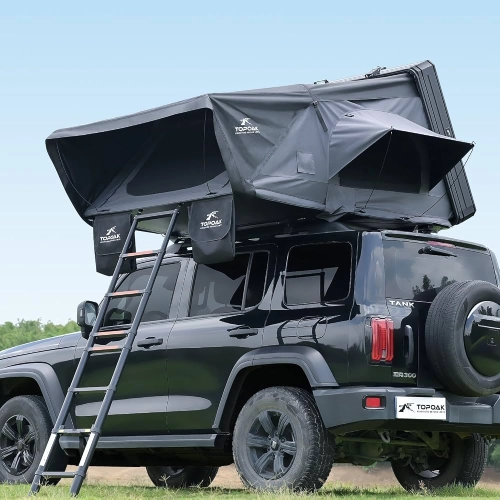
TopOak's rooftop tents all share the same core idea — a hardshell aluminum clamshell that pops open into a wedge shape — but they're priced and equipped differently enough that picking the wrong one matters.
Model | Price (Sale) | Weight | Best For |
Galaxy Light | $1,318 | 152 lbs | Lightest option, fits under most garage doors closed |
Galaxy 1.0 | $1,818 | ~155 lbs | Simple, no-frills hardshell at the lowest full-feature price |
Galaxy Pro | $1,818 | 165–172 lbs | Most features: solar prep, heater port, power console |
Stellar (Galaxy 2.0) | $1,818 | ~165 lbs | Updated version of the Galaxy platform |
Vision | $1,818 | ~165 lbs | Alternate shell styling, same core hardware |
Nebula | $1,969 | ~170 lbs | Top of the range, most premium finish |
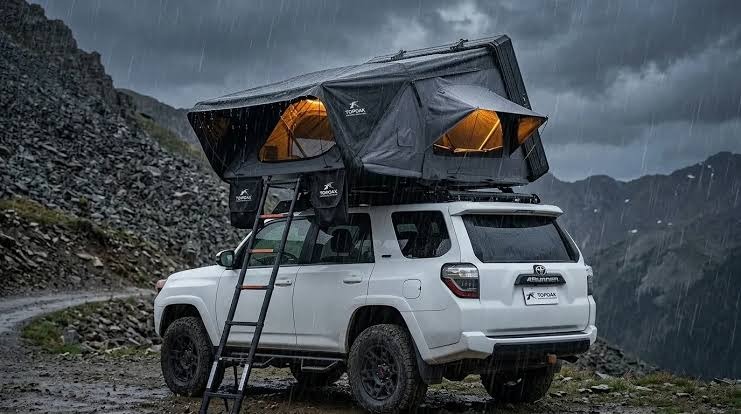
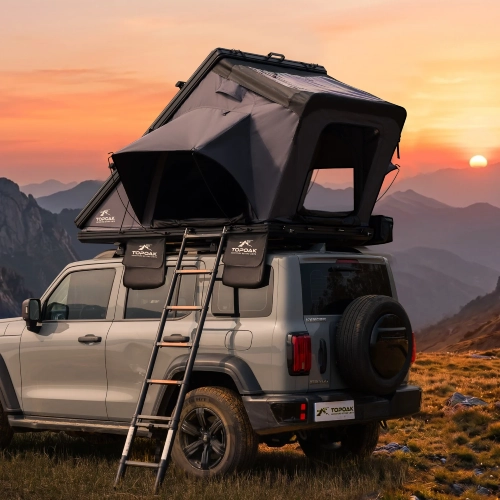
The Galaxy Pro is the model most independent reviewers have actually tested, and it's a useful stand-in for what the whole lineup does well. It opens into an 83" x 56" footprint with a closed height of just 8 inches — noticeably lower than fold-out soft-shell tents, which typically close around 17 inches and create more wind noise and drag on the highway. Inside, a triple-layered mattress with a velvet-finish cover sits under a lined ceiling, and the tent adds six interior storage pockets plus two exterior shoe bags. The Pro-specific extras are where TopOak tries to earn its slightly higher price within its own lineup: dedicated solar panel mounting channels, an Anderson SB50 connector for solar integration, a built-in heater port, and an interior control panel with charging ports and a 12V accessory outlet.
Construction-wise, every model in the lineup uses a hardshell aluminum clamshell rather than a soft fabric fold-out design, which is the main reason these tents survive rain, wind, and snow loads better than canvas alternatives. The canopy itself is a 300gsm poly-cotton blackout blend with an anti-condensation coating, a detail that matters more than it sounds: condensation buildup on the ceiling is one of the most common complaints with budget rooftop tents, and a coating that actively resists it is not something every brand in this price range bothers to include. Opening and closing is assisted by Stabilus hydraulic struts rated to support roughly 100 lbs of additional force, plus a removable telescoping center support pole that simplifies setup and breakdown once you've done it a few times. A ladder with three mounting positions and its own storage bag rounds out the package, letting you angle entry based on how your vehicle sits once the tent is mounted.
Pros and Cons
Pros
• Roughly half the price of comparable hardshell tents from iKamper, Roofnest, and Tuff Stuff Overland
• Comfortable stock mattress that testers specifically praised for reducing morning soreness
• Low 8-inch closed height on the Pro model improves fuel economy and wind noise versus fold-out tents
• Pro model's integrated power console and solar prep are rare at this price point
• 3-year warranty and 30-day returns, backed by free shipping
Cons
• Installation genuinely requires multiple people — testers needed three and several hours for a first install
• The Galaxy Pro's rainfly is awkward to manage, noisy in wind, and doesn't fully retract with the shell
• Heavier than premium competitors (165–172 lbs vs. 140 lbs for a Roofnest Falcon 3 EVO)
• Limited brand transparency — no detailed founding story or team information published
• Not ideal for anyone who wants to install and remove the tent frequently rather than leave it mounted
What Real Testers Are Saying
"The interior felt roomy for a hardshell RTT." — GearJunkie, Galaxy Pro field review
"I slept well and didn't wake up with the usual soreness." — GearJunkie, on the stock mattress
"The rainfly was the problem... I really am considering cutting the thing off." — GearJunkie, on the Galaxy Pro's rainfly design
"[TopOak] wins on price and included features, delivering much lower cost while offering comparable sleeping space and deployment speed." — GearJunkie, comparing the Galaxy Pro to the Roofnest Falcon 3 EVO
"An affordable option within the hardshell rooftop tent category." — Men's Journal, on the Galaxy Light, tested across North Carolina and Virginia
How TopOak Compares to the Competition
Brand & Model | Price | Weight | Notable Trait |
TopOak Galaxy Pro | $1,818 | 165–172 lbs | Best price-to-feature ratio; rainfly is the weak point |
Roofnest Falcon 3 EVO | ~$3,000–$3,998 | 140 lbs | Lighter, more refined, far more expensive |
iKamper Skycamp 2.0 | $3,699 | ~163 lbs | Premium finish and brand reputation, big price jump |
Tuff Stuff Overland Alpha | $3,603 | 176 lbs | Similar weight to TopOak, over double the price |
The pattern across every comparison is consistent: TopOak's closest competitors cost roughly $1,800 to $2,200 more for a similar or only modestly better experience. Roofnest wins on refinement and weight savings, and iKamper wins on brand reputation and resale value, but neither delivers a night-and-day improvement in actual sleeping comfort over the TopOak Galaxy Pro — which is the metric that matters most once you're actually camping.
Who Should (and Shouldn't) Buy TopOak
Good Fit: The Budget-Conscious First-Timer
If this is your first hardshell rooftop tent and you're not sure you'll use it every weekend, TopOak lets you try the format without the $3,500+ buy-in that Roofnest or iKamper demands. The Galaxy 1.0 or Galaxy Light covers the core experience at the lowest entry price in the hardshell category.
Good Fit: The Solar-and-Power Overlander
Anyone already running a solar setup on their rig will get real use out of the Galaxy Pro's dedicated mounting channels and Anderson SB50 connector — features that usually require aftermarket modification on competitor tents.
Weak Fit: The Frequent Mounter/Dismounter
If you plan to take the tent on and off the roof rack regularly rather than leaving it mounted for a season, the multi-person install and the Galaxy Pro's fiddly rainfly will get old fast. A soft-shell tent or a lighter hardshell is a better fit for that use case.
Weak Fit: The Weight-Obsessed Highway Driver
If fuel economy and roof weight are a top priority and budget is genuinely not a constraint, the 25–30 lb weight savings on a Roofnest Falcon justifies the higher price for some buyers.
Our Top Pick in the Lineup
For most buyers, the Galaxy Pro ($1,818) is the smartest purchase in the TopOak catalog. It carries the full feature set — solar prep, power console, heater port, upgraded mattress — at the same price as the more basic Galaxy 1.0 and Vision models, with only a modest weight penalty. Buyers who specifically want the lightest possible setup, or who know they'll never use the solar/power features, can save real installation hassle by stepping down to the Galaxy Light instead, which skips the Pro's rainfly complications entirely along with its added weight.
Pricing and Where to Buy
TopOak sells exclusively through its own site, topoakoverland.com, with current sale pricing roughly 7–8% below list across the tent lineup (for example, the Galaxy Pro's $1,968 list price is commonly discounted to $1,818). Shipping is free across the contiguous US, and the company insures shipments given the tents arrive in crates well over 150 lbs. Budget separately for accessories if you want the full setup: the optional Air & Foam Camping Mattress upgrade runs around $159–$198, and the matching 270-degree awning adds roughly $599–$899 depending on width. Because installation is a two-to-three-person job that can take several hours the first time, plan your purchase around a weekend when you'll have help on hand rather than trying to install it solo the evening it arrives.
Frequently Asked Questions
Is TopOak Overland a legitimate company?
Yes. TopOak sells real, in-stock products with a 3-year warranty and 30-day return policy, and its tents have been independently tested and reviewed by outlets including GearJunkie and Men's Journal — a level of third-party scrutiny that dropshipping storefronts typically don't attract.
Is the TopOak Galaxy Pro worth it over the cheaper Galaxy 1.0?
If you want solar mounting, a power console, and a heater port, yes — the Pro adds those for no extra cost over the Galaxy 1.0 at current sale pricing, though it does add some weight and the more complicated rainfly.
How does TopOak compare to iKamper or Roofnest on price?
TopOak's hardshell tents run $1,300 to $2,100, while comparable iKamper and Roofnest models run $3,000 to $4,000 — roughly half to a third of the cost for a similar sleeping experience, according to independent testers.
Can one person install a TopOak rooftop tent alone?
It's not recommended. Independent testers needed three people and several hours for their first installation of the Galaxy Pro, given its 165+ lb weight.
Does TopOak's roof rack support the tent's full weight?
Your vehicle's roof rack needs a dynamic weight capacity of at least 172 lbs to safely carry a Galaxy Pro, and that figure doesn't include the sleepers once the tent is deployed. Check your rack's rated dynamic capacity before ordering, since this is the single most common installation mistake first-time rooftop tent buyers make.
PickSuperb Scorecard
Category | Score |
Value for Money | 9.0 / 10 |
Comfort | 8.0 / 10 |
Ease of Setup | 5.5 / 10 |
Build Quality | 7.5 / 10 |
Warranty & Support | 7.5 / 10 |
Overall PickSuperb Score | 7.3 / 10 |
Final Verdict
TopOak Overland delivers on the value half of its "explore further, camp better" promise more convincingly than the convenience half. The core hardshell experience — comfort, weather protection, low closed height — genuinely competes with tents costing two to three times as much, which is a real achievement for a direct-to-consumer brand. Where it falls short is in the install experience and the Galaxy Pro's rainfly, both of which matter more to buyers who move their tent often than to buyers who mount it once per season and leave it. For most budget-conscious overlanders, the Galaxy Pro earns a genuine recommendation; just plan for a multi-person install and budget patience for the rainfly.
Written by
Jessica Reed
You might also like
 Travel
Mooncool Ride Beyond Ordinary
By Jessica Reed
May 21, 2026
 Travel
Sykes Cottages Review: Is It Worth Booking?
Sykes Cottages review for UK staycation planners-property quality, booking flow, fees, cancellations, and what to check before you book.
By Jessica Reed
Mar 4, 2026 · 8 min read
 Travel
Gear That Leads the Front Line Elevate Your Mission with First Tactical
By Jessica Reed
Feb 25, 2026 · 1 min read
0 Comments
No comments yet - be the first to share your thoughts.