
There is a specific kind of tired that doesn’t go away with more hours in bed. You sleep eight hours, wake up feeling like you slept five, and have no idea why. You’ve tried earlier bedtimes. You’ve tried melatonin. You’ve tried blackout curtains. Nothing changed. And then someone tells you the problem might be that your bed is too warm and you dismiss it because that sounds too simple to be real.
For a meaningful number of people — probably more than realize it — that’s exactly what the problem is. Not stress. Not screen time. Not poor sleep habits. A body that can’t cool down properly because the surface it’s lying on traps heat and returns it throughout the night.
Eight Sleep built an entire company on that insight. Not a mattress company, not a wearable company — a temperature management company that happens to make something you sleep on. The Pod 5 is what a decade of iteration on that original idea looks like, and it’s genuinely different from everything else in the sleep improvement category.
The Eight Sleep Origin — Why This Exists
Eight Sleep launched in 2014 with a premise that was obvious once someone said it and completely absent from the market before they said it: the thermal environment of your sleeping surface matters more than almost any other environmental factor for sleep quality, and nobody was doing anything meaningful about it.
The mattress industry was focused on materials — foam density, coil count, pressure relief. The wearables industry was focused on tracking — heart rate, steps, sleep stages. Eight Sleep’s founders looked at the sleep research showing that body temperature regulation during sleep was one of the primary drivers of sleep quality and decided to own that problem at the hardware level.
The first version was modest. Each iteration — Pod 2, Pod 3, Pod 4 — added sensor accuracy, software intelligence, and hardware refinement. The Pod 5, which launched in May 2025, represents the current state of that decade-long iteration. Three models, significantly upgraded sensors, Autopilot 4.0 released in April 2026, and a product that’s materially more capable than anything that existed when the company started.
What Eight Sleep Makes — The Current Lineup
The product architecture is cleaner than it’s ever been. Three Pod 5 models at different price and feature levels, plus add-ons that extend the system.
The Pod 5 Core is the entry point — the cover and hub that goes on any mattress 10 to 16 inches thick. Full-size through Cal King. Active dual-zone water cooling and heating from 55°F to 110°F per side. The biometric sensor array in the cover. Autopilot. This is the product that represents what Eight Sleep is — everything else is either less capable or more elaborate.
The Pod 5 Plus adds the hydro-powered Pod Blanket. The blanket uses the same water-circulation technology as the cover, extending the temperature management system from below you to above you simultaneously. For extreme hot sleepers who’ve found that cooling the mattress surface alone doesn’t fully solve the problem — heat accumulates above the body under conventional covers — the blanket creates what Eight Sleep calls a fully immersive thermal environment. Both surfaces managed. No trapped heat anywhere in the sleeping system.
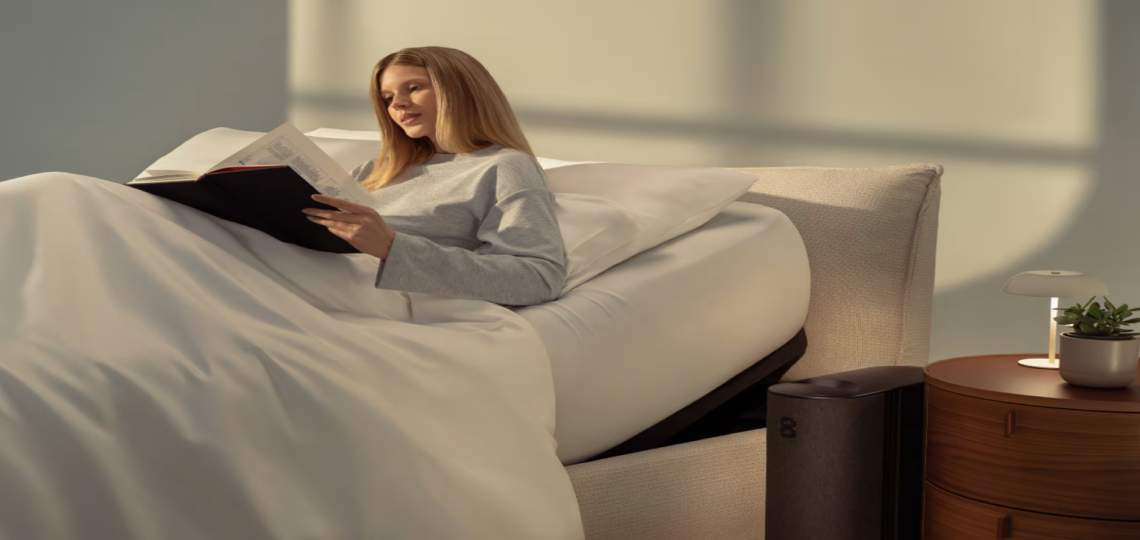
The Pod 5 Ultra adds the adjustable Base to the cover. The Base slides under the mattress and serves two functions. First: head and foot elevation for sleeping position adjustment, pressure relief, and the zero-gravity position that some people find genuinely helpful for lower back comfort. Second: snore detection and automatic head elevation response. When the sensors detect snoring, the Base gently elevates the head position to open the airway — no waking up, no device to wear, just a mechanical adjustment that addresses positional snoring without requiring the snorer to do anything. The Ultra Base also has an integrated speaker for soundscapes, white noise, and Non-Sleep Deep Rest content from Andrew Huberman.
The Pod Blanket and Pod Base are available as separate add-ons to the Core for buyers who want to build the system incrementally rather than committing to the full Ultra from the start.
The Autopilot System — Where the Intelligence Lives
Temperature control alone would be a well-executed cooling pad. Autopilot is what makes it a sleep system.
The sensor array in the cover — significantly upgraded in the Pod 5 versus Pod 4 — detects heart rate, HRV, breathing rate, and movement without requiring the user to wear anything. These signals feed into Autopilot, which builds a model of your individual sleep architecture over the first two weeks of use and then operates against that model every night.
What this looks like in practice: the Pod starts cooling 30 to 60 minutes before your typical bedtime — pre-cooling the surface to initiate the body temperature drop that signals sleep onset. During the deep sleep phases that dominate the first half of the night, Autopilot holds the cooler temperatures that support slow-wave sleep and the growth hormone release that drives physical recovery. As sleep transitions toward lighter stages and REM in the second half, the temperature profile adjusts. Before your alarm, warming begins gradually — using temperature as a physiologically aligned wake signal rather than a jarring sound interruption.
Autopilot 4.0, which arrived in April 2026 as a free update for all active subscribers, added integration with Apple Health and Google Health Connect. The system now ingests daytime activity data — exercise, steps, readiness scores from other apps — and uses that information to predict and optimize the coming night before it starts. A hard training day is recognized before bedtime and recovery-focused temperature management runs without the user having to do anything. The morning brief that Autopilot 4.0 produces explains in plain language what happened during the night and why — not just a score, but a readable account of the sleep that makes the data useful rather than just interesting.
The Health Tracking — What the Pod 5 Measures and How Well
Eight Sleep has been careful about health claims since the regulatory environment around medical device classification is complex and they want to stay clearly in the consumer wellness space. But the biometric data the Pod 5 produces has become genuinely useful as the sensor accuracy has improved with each generation.
Heart rate measurement from the Pod 5 is accurate to within a few beats per minute during the still periods that make up most of sleep. HRV measurement — the metric most actively used by health-focused users for daily recovery assessment — tracks consistently enough that week-over-week trends are meaningful. Sleep stage classification is good for trend awareness and should be treated as directional rather than clinical-grade, which is true of every consumer sleep tracker regardless of price or measurement method.
The biometric data that Pod 5 users find most immediately actionable is HRV. A declining HRV trend over several days is a signal that physiological stress is accumulating — whether from overtraining, illness onset, alcohol consumption, or lifestyle stress — before symptoms appear. People who check their HRV trend regularly through Eight Sleep consistently report that it changes how they manage their training load, alcohol intake, and recovery practices. The signal has value even when the absolute numbers vary slightly from a dedicated wearable like a WHOOP or Oura Ring.
Dual Zone — The Feature That Matters Most for Couples
Every Pod 5 model — Core, Plus, Ultra — includes dual-zone temperature control. Independent water circuits for each side of the bed, independent Autopilot profiles, independent vibration alarms.
This is worth treating as a central feature rather than a bullet point. Two people in the same bed with different thermal needs have no good solution with conventional bedding or room temperature management. One person is comfortable and the other isn’t, or both are compromising and neither is optimal. The Pod 5 gives both people the temperature they actually need simultaneously.
The thermal separation between zones in the Pod 5 is clean. The water circuits are independent and there’s no meaningful bleed of temperature from one side to the other under normal sleeping arrangements. One person’s side running at 60°F doesn’t significantly affect a partner sleeping at 75°F on the other side.
One membership covers both zones. Both people get full Autopilot, independent sleep tracking, and independent alarm profiles under the same subscription.
What Eight Sleep Gets Right
The technology is real. Active water cooling removes heat from the sleeping surface rather than absorbing it — the fundamental difference between the Pod and passive cooling products that saturate and stop working. The dual-zone implementation is the best available for couples with different thermal needs. Autopilot’s improvement with more data is genuine — six months in performs noticeably better than week two.
The software commitment is serious. Autopilot 4.0 being delivered free to existing subscribers is a meaningful gesture in a product category where companies often charge for feature updates. The ongoing software investment makes the hardware purchase more durable.
Where Eight Sleep Falls Short
The price is genuinely high. The Pod 5 Core starts at approximately $2,949 for a Queen at standard pricing. The Ultra with its Base starts above $4,900. These numbers are real and not everyone can or should justify them.
The subscription is a permanent ongoing cost. Autopilot requires active membership — the subscription isn’t optional if you want the system to function as designed. Some buyers find this structurally objectionable regardless of the monthly amount.
The Hub is not silent. Quieter than earlier generations — significantly quieter than the Pod 3 — but present as a low background noise. Most people stop noticing within a week. Some light sleepers don’t.
The system requires WiFi for normal operation. A Backup Mode for Bluetooth-only control arrived in late 2025 but full functionality requires connectivity.
Is Eight Sleep Worth Buying
For hot sleepers who’ve tried passive solutions — fans, cooling toppers, gel pillows, aggressive thermostat settings — and still wake up overheated regularly: yes, unambiguously. The Pod 5 addresses the sleeping surface temperature problem at a level no passive product can match and the improvement for this group is often immediate and substantial.
For couples where temperature is a source of either sleep disruption or household negotiation: yes, for the same reasons. The dual zone is the only real solution to this problem.
For people whose sleep problems are not temperature-related: no. Anxiety, pain, apnea, noise — Eight Sleep doesn’t address these and spending $3,000+ on a product that isn’t solving your problem is never the right call.
Products Section:
Pod 5 Core — Cover + Hub, dual-zone, full Autopilot. Queen from ~$2,949. The right starting point for most buyers.
Pod 5 Ultra — Core + Adjustable Base with snore response, integrated speakers, NSDR content. Queen from ~$4,899. The right choice if snoring or base elevation are relevant to your situation.
Pod Blanket — Hydro-powered temperature-controlled blanket, works in sync with the cover. ~$1,049. The upgrade for hot sleepers who need both surfaces managed.
Autopilot Membership — Required for smart features. Multiple tiers. One subscription covers both sides for couples.